
Around a third of cars fail their first MOT attempt each year — and a large share of those failures are for faults that cost nothing, or a few pounds, to put right before the test. A blown bulb, an empty screenwash bottle, a tyre worn past the legal limit.
This page ranks the most common MOT failure reasons using DVSA data, explains what each one actually means, and gives you the ten-minute check that catches most of them at home, free.
The most common MOT failure reasons, ranked
The DVSA groups every defect recorded at test. Lighting and signalling faults have been the largest single group for years — industry analysis of DVSA data puts lighting at roughly a quarter to over a third of all defects recorded, depending on the year and how the categories are grouped. The ranking below reflects the order that appears again and again in DVSA statistics and tester surveys:
| Rank | Failure area | Typical faults |
|---|---|---|
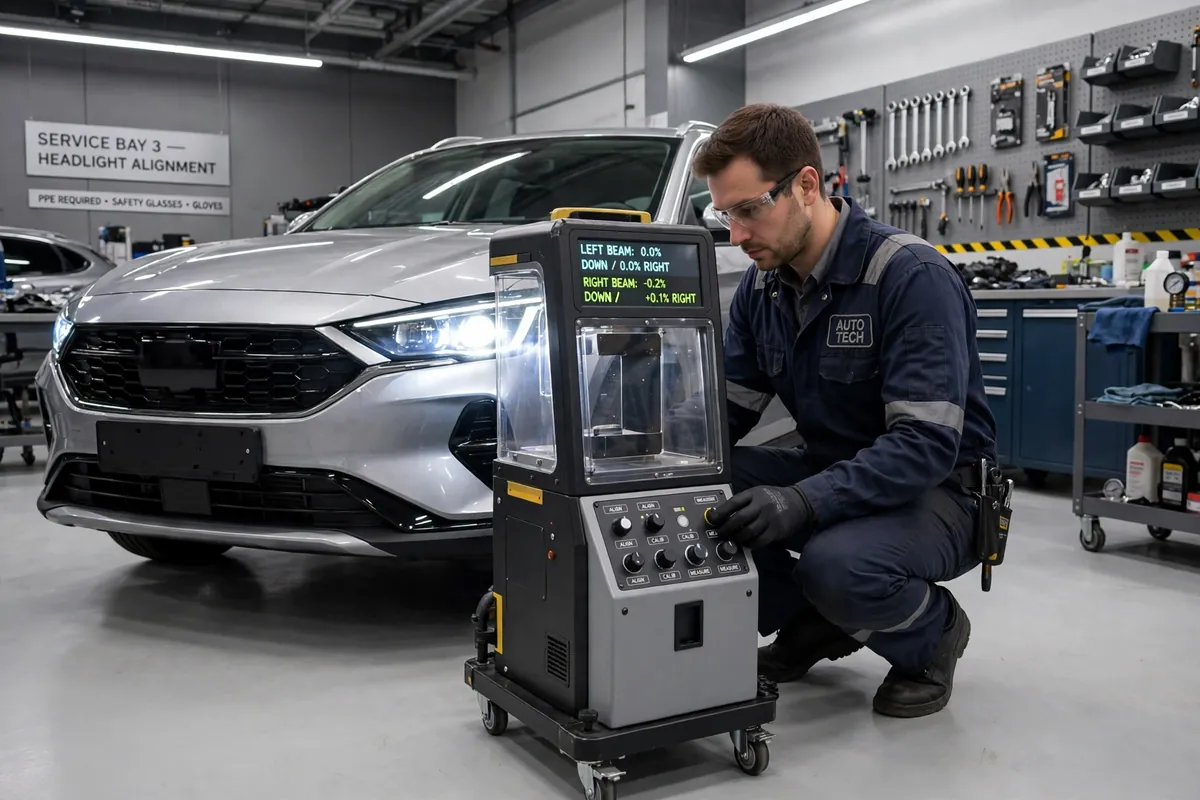
| 1 | Lamps, reflectors & electrical equipment | Blown headlamp, brake light or indicator bulbs; faulty number-plate lamp; headlamp aim wrong |
| 2 | Suspension | Worn or leaking shock absorbers, broken coil springs, worn bushes and ball joints |
| 3 | Brakes | Worn pads and discs, corroded brake pipes, weak parking brake, brake imbalance |
| 4 | Tyres | Tread below the 1.6mm legal minimum, cuts, bulges and damage exposing the cord |
| 5 | Driver’s view of the road | Windscreen chips and cracks in the swept area, worn wipers, empty or faulty washers |
| 6 | Body, chassis & structure | Corrosion weakening prescribed areas (sills, seat-belt and suspension mounts) |
| 7 | Exhaust & emissions | Leaking or insecure exhaust, emissions above limits, missing or tampered diesel particulate filter |
| 8 | Steering | Play in the steering rack or column, leaking power steering, worn track-rod ends |
The important lesson sits in rows 1, 4 and 5: three of the most common failure areas are things you can inspect yourself, in daylight, in ten minutes.
The ten-minute check that catches most cheap failures
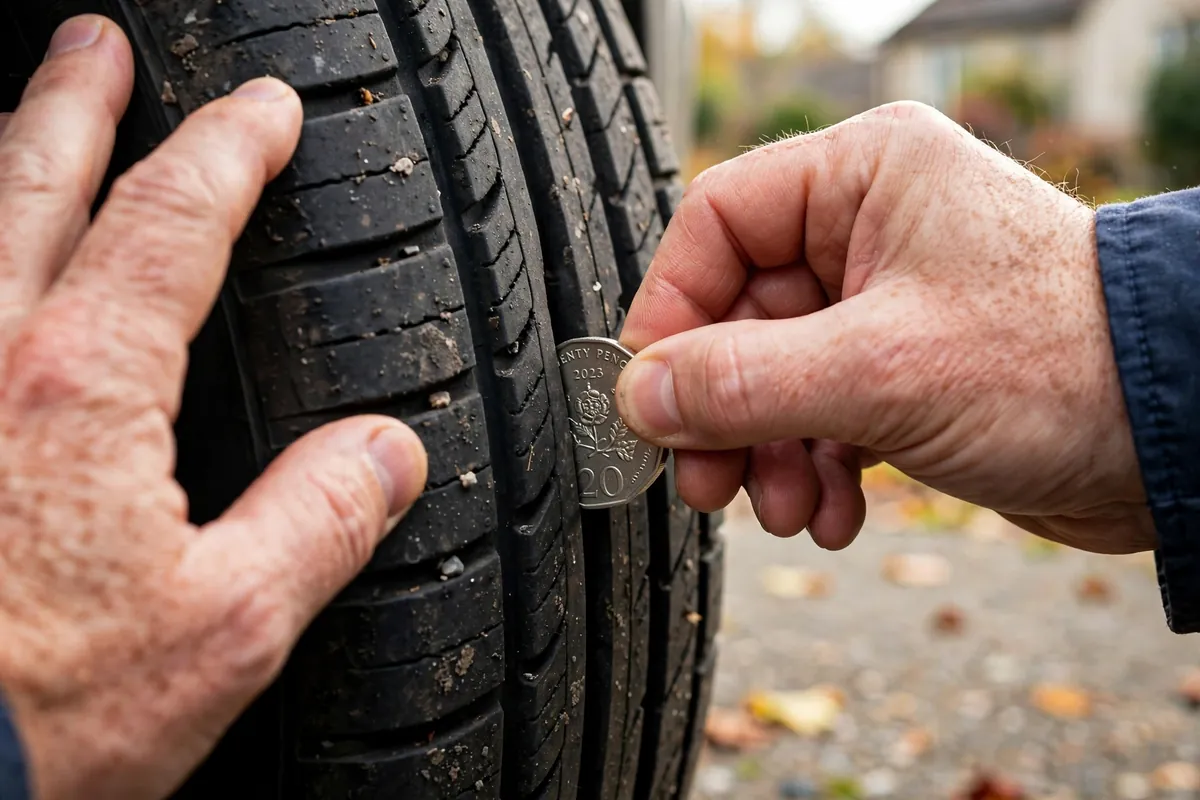
Work through this list the weekend before the test. None of it needs tools beyond a torch and a 20p coin.
- Every light, one by one. Headlights (dipped and main beam), sidelights, indicators, brake lights (ask someone to watch, or reverse up to a wall and watch the reflection), number-plate light, fog light and hazard lights. A replacement bulb is a few pounds; a failed test over one is entirely avoidable.
- Tyre tread with the 20p test. Push a 20p coin into the main grooves. If the coin’s outer band is hidden, the tread is above 1.6mm; if the band shows, the tyre is at or below the legal limit and will fail. Check all four tyres — and the condition, not just the depth: cuts, bulges and cracks fail too.
- Wipers and washers. Worn blades that smear, and washers that are empty or blocked, are failures, not trivia. Top up the screenwash — it takes a minute.
- The windscreen. Damage bigger than 10mm in the zone directly in front of the driver, or 40mm elsewhere in the swept area, fails. Small chips are cheap to repair early and expensive once they crack.
- Horn, mirrors, seatbelts and doors. The horn must work, mirrors must be present and secure, every seatbelt must latch and retract, and doors must open and close from inside and out.
- Number plates. Plates must be clean, legible, correctly spaced and securely fixed. A dirty plate is an absurd way to fail.
- Warning lights. An illuminated ABS, airbag, engine-management or TPMS light is a failure. If one is on, get it diagnosed before the test, not at it.
- Clear the car out. Remove anything blocking the driver’s view (dashcams and mounts placed in the swept area can fail), child seats that prevent a belt check, and boot clutter that hides the spare-wheel area.
What “dangerous”, “major” and “minor” actually mean
Since 2018 every defect is graded. A dangerous defect is a direct and immediate risk to road safety or the environment: the car fails, and it must not be driven at all until it is repaired — driving it is an offence. A major defect also fails the car, but it may be driven to a pre-arranged repair.
Minor defects and advisories do not fail the car — they are recorded warnings, and they are exactly what our MOT history checker shows you when you look up a car’s past. Treat an advisory as next year’s failure arriving early, and budget for it.
Failed? The retest rules in brief
A fail is not always a second full fee. If the car is repaired and retested at the same centre by the end of the next working day for certain listed items — bulbs, wipers, washers, mirrors, horn, number plates and similar quick fixes — the partial retest is free. Leave the car at the test centre for repair and retest within ten working days and the partial retest is also free.
Take it elsewhere and return within ten working days and you pay a partial retest fee; after ten working days, or with new faults outside the original list, it is a full test at the full fee. The official wording is in GOV.UK’s guide to getting an MOT. And remember the driving rule: after a fail you may only drive the car if your previous certificate is still in date and the car has no dangerous defect.
Already failed? Our complete guide to what to do after a failed MOT covers the first 24 hours, your driving rights, the retest deadlines and the appeal route in full.
What does an MOT cost?
The maximum fee the DVSA allows a test centre to charge for a standard car (Class 4) is £54.85 — a cap that has not changed since 2010. Centres may charge less, and many discount to around £40–45, but no one may charge more.
There is no VAT on the test fee. Motorcycles (Class 2) are capped at £29.65 and larger vans (Class 7) at £58.60. For every class, retest fees and Northern Ireland prices, see how much an MOT costs.
Failure questions drivers ask
What is the single most common MOT failure?
Lighting. Blown bulbs and faulty lamps are the largest defect group in DVSA data year after year — and the cheapest to prevent, with a two-minute walk-around check and a bulb that costs a few pounds.
Can a car fail on an empty screenwash bottle?
Yes. Washers that do not provide enough fluid to clear the windscreen are a failure item. It is the most avoidable fail on the list — top the bottle up before the test.
Is 1.6mm really the legal tyre limit?
Yes — 1.6mm across the central three-quarters of the tread, all the way round the tyre. Below that the tyre fails, and driving on it is an offence in its own right, with points and a fine per tyre.
My car failed but the old certificate is still in date — can I drive it?
Only if the failure included no dangerous defect. A dangerous defect makes the car illegal to drive immediately, whatever the old certificate says. With majors only, you may drive until the old expiry date — but you are responsible for the car being roadworthy, and the fail is already on the public record.
Rankings, defect categories and fees on this page were checked against DVSA statistics and GOV.UK guidance in November 2026. Check any car’s real failure history — free — with the MOT checker, and make sure you know your MOT due date before you book.