
Tax and MOT are two separate records, held by two different agencies — but you can check both free, online, in about a minute. The MOT side lives with the DVSA and is what this site checks in full.
The tax side lives with the DVLA, and GOV.UK’s tax check handily shows the MOT expiry date alongside the tax status. Here is how to check both together, what each result means, and the rules that catch drivers out.
How to check tax and MOT together, step by step
- Start with the MOT record. Enter the registration in the checker on our homepage. You get the current MOT status, the exact expiry date, and the full test history — every pass, fail, advisory and mileage reading since 2005.
- Then check the tax. Go to GOV.UK’s vehicle tax check, enter the same registration and confirm the vehicle make. It shows whether the vehicle is taxed, when the tax runs out, and — usefully — the MOT expiry date too, so you can cross-check the two.
- Compare the dates. The two records run on completely separate clocks. A car can be taxed with an expired MOT, or have a fresh MOT and no tax. Both must be in date, with insurance, before the car can legally be driven.
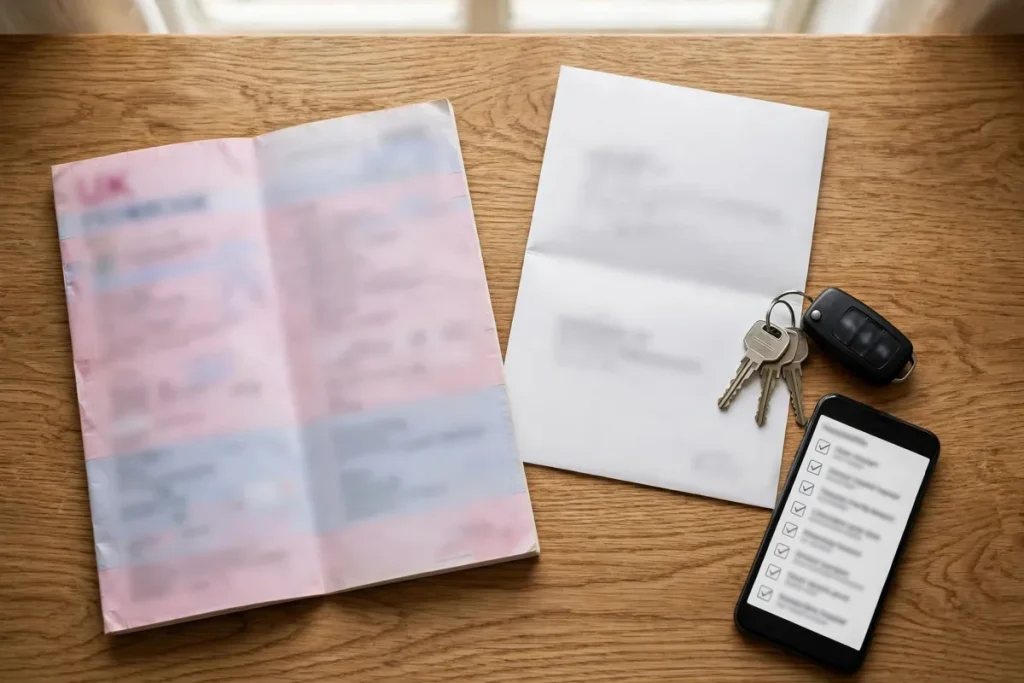
What each record actually tells you
| Record | Held by | What it shows |
|---|---|---|
| MOT status and history | DVSA | Current pass/fail status, expiry date, every test since 2005 with defects, advisories and mileage |
| Vehicle tax status | DVLA | Taxed, untaxed or SORN; the date the tax expires; the MOT expiry date alongside |
The distinction matters most when you are buying. The tax check tells you the car’s legal standing today; the MOT history tells you how the car has been looked after for years — which is why the full record, not just the status, is the one to read before money changes hands. Our used car MOT check walks through it in five steps.
Can you tax a car without an MOT?
Normally, no. When you tax a vehicle, the system checks the MOT database, and a vehicle that needs an MOT but does not have a current pass cannot be taxed until it passes.
There are only two real exceptions: vehicles under three years old, which do not need an MOT yet, and vehicles that are formally MOT-exempt — most notably historic vehicles over 40 years old that have not been substantially changed.
The order of events for an expired car is therefore fixed: book the test, drive there under the pre-booked-test rule explained on our driving without an MOT page, pass, and only then can the tax be bought.
Bought a car? The tax does not come with it
Since 2014, vehicle tax has not transferred with the car. The moment a vehicle is sold, its tax is cancelled and the previous keeper is automatically refunded for any complete remaining months.
As the buyer, you must tax the car in your own name before you drive it — even if the windscreen maths suggests months are left. You can do it online in minutes using the reference number on the new keeper slip or the V5C log book, following GOV.UK’s vehicle tax guide.
And the car still needs its own valid MOT and your insurance before it moves — taxing it does not cover either.
Not using the car? SORN it
If a vehicle is kept off the public road — in a garage, on a drive or on private land — you can take it off the road officially with a SORN (Statutory Off Road Notification) instead of taxing it.
A SORN is free, lasts until you tax the vehicle again, and is the only legal alternative to tax for a vehicle you own. What you cannot do is leave an untaxed, un-SORNed vehicle on a public road: that is an offence in itself, and the DVLA clamps and impounds untaxed vehicles. The application is at GOV.UK’s SORN page.
The penalties, side by side
| Situation | What happens |
|---|---|
| Driving or keeping a vehicle with no tax and no SORN | Automatic £80 penalty from the DVLA (halved if paid promptly), rising to a fine of up to £1,000 if it reaches court; the vehicle can be clamped or impounded, with release fees on top |
| Driving with no valid MOT | Fine of up to £1,000 (a £100 fixed penalty is typical), no penalty points for the MOT offence itself |
| Driving with a dangerous defect | Up to £2,500 and 3 penalty points, plus a possible driving ban — whichever record has expired |
Insurance sits alongside both: driving uninsured is a separate offence again, and an expired MOT can give an insurer grounds to dispute a claim, as our driving without an MOT page explains.
Questions everyone asks
Is the vehicle tax check free?
Yes. GOV.UK’s tax status check is free, needs no account, and asks only for the registration number and the vehicle make. The full MOT history check on this site is free too — beware copycat sites that charge for either record.
Does the tax check show the MOT date as well?
Yes. GOV.UK’s tax check displays the MOT expiry date next to the tax status, which makes it the quickest single place to see both headline dates. For the full MOT record behind that date — the failures, advisories and mileage — you need the history check on this site.
My tax is valid but the MOT has expired. Can I drive?
No. Tax, MOT and insurance are three separate requirements and all three must be in place. A taxed car with an expired MOT can only be driven to a pre-booked MOT test, in a roadworthy condition — our MOT due date page covers what to do the moment you realise it has expired.
How do I tax a car I have just bought?
Tax it before you drive it, in your own name — the seller’s tax ended when the car was sold. You will need the reference number from the new keeper slip (or the V5C if it is already in your name), and the vehicle must have a valid MOT if it needs one. The whole process is online at GOV.UK and takes a few minutes.