
Before you view any used car, run its registration through a free MOT history check. It takes under a minute, the seller cannot edit it, and it is the single most honest document in the whole transaction.
This guide turns that record into a step-by-step buying routine: what to check before you travel, what the red flags look like, what to verify against the physical car, and when to walk away.
Step 1 — Get the registration number (and treat refusal as an answer)
Ask the seller for the registration before anything else. It is on every advert photo of the number plate anyway. A seller who will not give it is telling you something: the record is public, checking it costs nothing, and the only reason to block the check is what the check would show. Walk away from refusals without regret.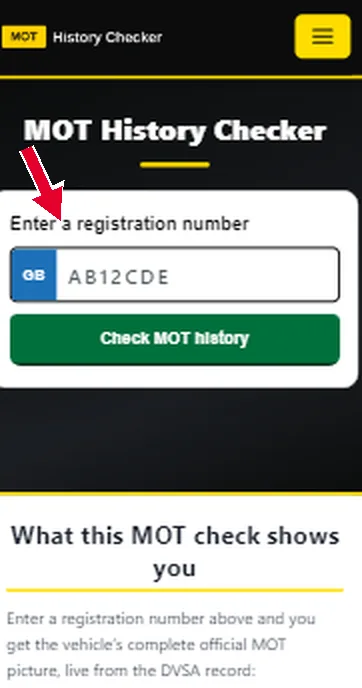
Step 2 — Read the record in this order
- Status and expiry. Is the car currently tested, and for how long? A car with eleven months of MOT is worth more than the identical car with six weeks — and a car with no MOT must be priced and moved accordingly (the driving rules are strict; see our driving without an MOT guide).
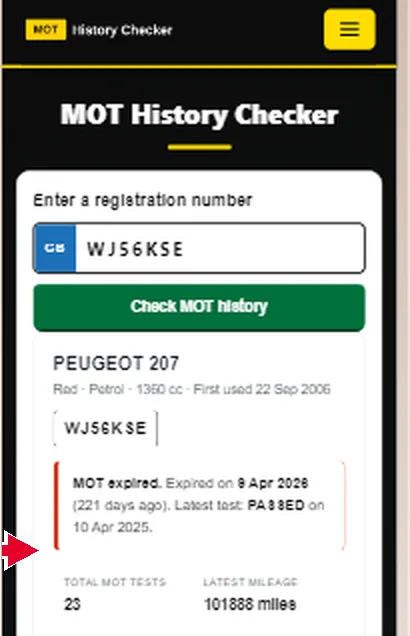
- The mileage story. Read the recorded mileages oldest to newest. They should climb steadily. A drop is the classic clocking sign; a sudden flat patch just before sale deserves questions. Our MOT history guide shows a real record read in full.
- The failure pattern. Occasional fails on wear items are normal on older cars. Fails for structural corrosion, brakes and suspension — especially repeated — describe a car that is being run on the edge.
- The advisories. These are next year’s bills, written down in advance. Decode them with our advisories decoder: budget items are fine, repeat advisories mean unfixed faults, and corrosion near mountings is the walk-away note.
- Gaps and clusters. Missing years suggest time off the road. Several tests in a short burst can mean fail-shopping — a fail at one centre followed by a quick pass at another. Ask what was repaired, and ask for the invoices.
Step 3 — The red flags at a glance
| What you see | What it usually means | What to do |
|---|---|---|
| Mileage goes down between tests | Clocking, or a changed instrument cluster | Walk away unless there is documented proof of a cluster change |
| Same corrosion advisory 2–3 years running | Structural rust left untreated | Walk away, or price in welding after a proper inspection |
| Fail, then a pass days later elsewhere | Possibly a lenient retest rather than a repair | Ask for repair invoices for every failed item |
| Long gap in tests, then a sale | Car was off the road; storage faults likely | Inspect brakes, tyres and seals carefully; budget for recommissioning |
| Seller will not share the registration | The record is the problem | Walk away |
| Advisories for tyres/brakes “not fixed” but seller claims “all sorted” | Claims without evidence | Believe the record, or ask for receipts |
Step 4 — Cross-check the physical car against the record
The record tells you what to verify in person. The dashboard mileage should be a little above the last recorded test mileage — roughly consistent with the time since that test. The VIN plate (at the base of the windscreen and on the V5C) must match the document, and the V5C should be in the seller’s name and address if it is a private sale.
Look at the specific items the record flags: if the history shows tyre advisories, look at the tyres; if it shows an oil leak, look under the car. A seller whose car matches its record is a seller you can deal with.
The government’s own list of checks — including the stolen-vehicle and identity checks — is at GOV.UK’s checks when buying a used car. Combine it with this record check and very little can be hidden from you.
What a good record looks like
Complete, consistent and boring. Tests every year with no gaps, mileage climbing at a believable rate, advisories that appear once and never again (because they were fixed), and fails — if any — for honest wear items followed by passes.
The demonstration record on this site (a Peugeot 207, registration WJ56KSE — run it through the checker) shows exactly that pattern across 23 tests. You are not looking for a perfect record; you are looking for a maintained car, and maintenance leaves a paper trail.
What the MOT record cannot check
It does not show outstanding finance, insurance write-off categories or stolen status, and it says nothing about the engine’s internals, clutch or gearbox. For a purchase of any real value, add a paid finance/write-off check and, ideally, an independent inspection. The MOT history is the free first filter: it removes the bad cars from your list before you spend anything at all.
Buying questions
Will the seller know I checked the MOT history?
No. The record is public and checking it leaves no trace. You do not need the seller’s permission, an account, or the V5C — just the registration number.
The car has a private plate — which registration do I check?
Check the current plate first. If the record looks short or broken, a recent plate transfer may have split it; ask the seller for the previous registration and check that too.
Can I legally drive a car home if it has no MOT?
Only to a pre-booked MOT test, driven directly, in a roadworthy and insured car. “Driving it home to sort out later” is not a legal journey. The alternatives are booking a test near the seller or having the car transported — the full rules are on our driving without an MOT page.
Is it different buying from a dealer?
The check is the same, and dealers’ cars deserve the same scrutiny — the record does not care who is selling. Consumer law gives you more protection with a dealer (the car must be as described and of satisfactory quality), but a bad MOT history is a reason to choose a different car, not to rely on a refund argument later.
The checks on this page are based on the public DVSA record and GOV.UK buying guidance, checked November 2026. Start every purchase the same way: the registration in the free MOT checker, five minutes with the record, then decide if the car deserves a viewing.